Connecting The Dots
A Review of "Project Hail Mary"
No, the “Hail Mary” here has nothing to with religion, although it very much refers to faith.
Faith in believing that having hope can mean, in this case at least, survival.
The movie starts in darkness, in deep space.
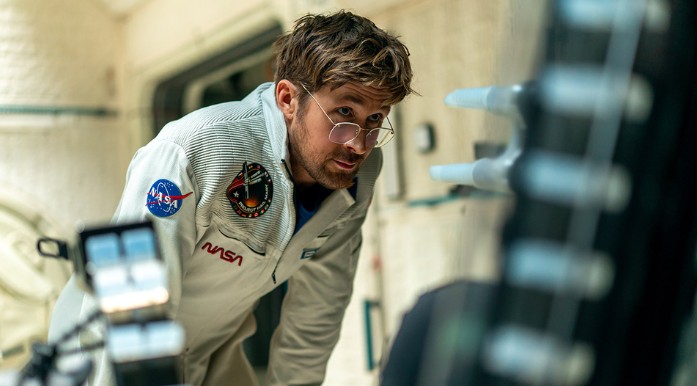
Rylance Grace, played by Ryan Gosling in a charismatic turn, wakes aboard a vessel light-years from Earth and in a kind of stupor. He doesn’t immediately know who he is or where. And for the moment, thanks to a deep-space slumber, has no control over his own body.
He’s thinking, “How long have I been here?” And why. The same questions we as the audience have, too.
Slowly, Grace begins to get his bearings. And with the aid of smartly-paced flashbacks, we discover he is (was) a middle school science teacher, with an advanced degree in bio-something. So, you can add “Doctor” to his Grace.
And it’s a crucial clue to why he finds himself alone in the cosmos.
The movie then cuts to his appearance before a secretive scientific body that wants his theory about recently-discovered entities, the “dots,” that are slowly devouring the sun, causing it and other stars to dim. Urgent calculations suggest in 30 years, the Earth will cool to such an extent that half the human population will die.
So, Dr. Grace, the panel’s members ask, “What do you suggest we do, and how?”
Grace draws upon his science background and, with a microscope—natch--peers at the astrophages in an effort to study their behavior.
Later, back in space, he discovers he’s on a mission to find out why a single star is immune to the carnivorous dots. And that’s where his ship is headed.
It’s also critical to the story that Grace was part of a now-deceased crew that included a pilot. Suddenly this everyman is facing a fight for survival, using only his wits, much like Tom Hanks in “Castaway,” or Matt Damon in “The Martian,” a story also based on a book by Andy Weir.
The miracle of the film is Gosling’s command of the screen. His “gee-whiz” demeanor is endearing and his wide-eyed performance is natural, unforced.
Also noteworthy: the pair of directors chose to use practical effects instead of the now-standard acting in front of a green screen. That makes the sets all the more impressive.
I can’t be more descriptive of “Project Hail Mary” without introducing spoilers. Just know that (1) Grace’s participation in the scientific expedition was not voluntary (a key dramatic scene); and (2) he isn’t alone for long in space.
The movie has already been hailed as the best so far this year and has all the earmarks of a certified classic. It’s that good.
And so is Gosling, in arguably the best role of his career.
Do yourself a favor and don’t wait for streaming. Watch it on the biggest screen you can find and let its awe-inducing spectacle wash over you.